


Maintaining a tidy home doesnt always have to include strong smelling or irritating cleaning solutions.eco-cleaning agentsare becoming ever more popular as people, quite rightfully, have started to reconsider product content, packaging, waste disposal and effects on environment as much as performance. From natural based floor, to dish washing liquids, biodegradable laundry detergents and refillable surface sprays are all readily available options to help make the house sparkling with far less harsh substances.
But actually, are green cleaning agents superior, how should they be utilized as well as can such agents pose risk. This document discusses what green cleaning products are, what benefits these agents offer, the downfalls involved as well as factors and considerations related to these products, with reference to India as well customer service in India.
What Are Eco-Friendly Cleaning Products?
Eco-friendly cleaning products are house cleaning products formulated to have minimal effect on the environment, yet still clean dirt, grease, and odors, from the majority of surfaces and available in a variety of forms they utilize elements such as plant based or biodegradable ingredients, enzymes, concentrated formulas, or packaging that lessens waste; depending on the type of cleaning product used.
The word “eco-friendly” doesn’t automatically make a product chemical free or even safe. Everything is a chemical, even the most basic of cleaning agents. Shoppers need to examine what goes inside, how it breaks down, the packaging involved, how much is used, certifications and care labels to determine if a product is truly and in effect better for the environment.
Eco-friendly cleaners are now available for almost every household task, including:
- Floor cleaning
- Bathroom cleaning
- Toilet cleaning
- Dishwashing
- Laundry
- Glass and window cleaning
- Kitchen surface cleaning
- General-purpose cleaning
- Odour control
The Indian market is also significant and plant-based, bioenzyme and green-chemistry products are available via a variety of specialist web pages and e-commerce sites.
Why Are Eco-Friendly Cleaning Products Becoming Popular?
The chemical ingredients found in traditional household cleaners, the most apparent is strong fragrance, can include, as mentioned, Solvents, disinfectants or other active substances. Whilst they are effective for cleaning a range of uses, unnecessary exposure to, use and / or disposal of these chemicals can pose health/environmental problems.
Eco products do this by using biodegradable ingredients, surfactants based on plants, concentrated formulas, and also minimum packaging.
The second major factor driving their success is ease of use. Consumers can skip creating every cleaner from scratch. Pre-made, all-natural green cleaners for dishes, bathrooms, laundry and floors are convenient.
As part of recent Indian product listings: born good, koparo clean, herbal strategi, purecult, as well as specialist manufacturers of plant-based cleaners can be bought. For more related articles visit our website.
How Do Eco-Friendly Cleaning Products Work?
In general, ecofriendly cleaners work according to very many of the same chemical cleaning principals as regular ones. For instance surfactants loosen soil and grease enabling them to be washed away with water, enzymes will break down organic dirt such as grass stains and acids will work by dissolving mineral deposits and soap scumm.
Common ingredients you may find include:
Plant-Derived Surfactants
These ingredients help lift oils and dirt from surfaces. Some products use surfactants derived from coconut, corn, sugar or other renewable sources.
Enzymes
Enzymes can target substances such as food residues, proteins and other organic soils. They are particularly common in laundry and dishwashing products.
Citric Acid
Citric acid can help with mineral deposits and limescale. It is commonly used in bathroom and kitchen formulations.
Soapnut or Reetha Extract
Soapnuts contain natural saponins that can act as cleansing agents. Some Indian cleaning products use soapnut-derived ingredients.
Essential Oils
Some green cleaning products use essential oils for fragrance or specific formulation purposes. However, “natural” fragrance does not automatically mean that everyone will tolerate it equally well.
How to Use Eco-Friendly Cleaning Products

The correct way to use an eco-friendly cleaner depends on the formulation and the surface.
Always read the manufacturer’s label first instead of assuming that a natural product can be used everywhere.
1. Check the Surface
Before applying a cleaner, confirm that it is suitable for the material.
Stone, marble, wood, glass, metal, painted surfaces and fabrics can all react differently to cleaning ingredients.
2. Follow the Dilution Instructions
Some concentrated cleaners need to be diluted with water.
Using too much product does not necessarily produce better cleaning and can leave unnecessary residue.
3. Apply the Correct Amount
Use enough cleaner to cover the area without excessively soaking the surface.
For sprays, a small amount is often sufficient for routine cleaning.
4. Allow the Product to Work
Some cleaners need contact time to loosen dirt or perform their intended function.
Do not immediately wipe away every product unless the instructions specifically recommend it.
5. Wipe or Rinse
After cleaning, wipe the surface with a suitable cloth or rinse it where required.
6. Test an Unfamiliar Surface
If you are using a new cleaner on an expensive or delicate surface, test it on a small, inconspicuous area first.
How Useful Are Eco-Friendly Cleaning Products?
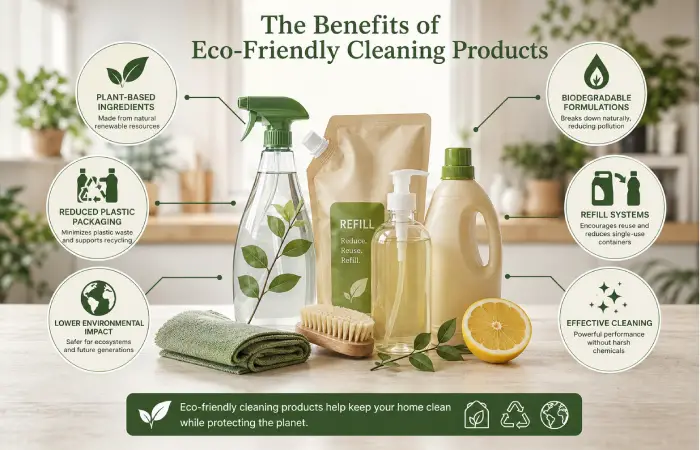
Eco-friendly cleaning products can be very useful for everyday household cleaning.
Their biggest advantage is that they allow consumers to reduce certain environmental impacts without completely changing their cleaning routine.
They Can Reduce Packaging Waste
Concentrates, refill packs and powder-based products can reduce the amount of packaging and water transported compared with repeatedly buying ready-to-use liquid products.
For example, some eco-cleaning retailers specifically promote concentrates and refill systems as a way to reduce plastic and shipping weight.
They Can Provide Effective Everyday Cleaning
A good eco-friendly cleaner should still perform its intended task.
Plant-based or biodegradable does not automatically mean weak. Surfactants, enzymes and other ingredients can provide effective cleaning without relying on exactly the same formulation used by conventional cleaners.
They Offer More Ingredient Choices
Consumers can choose between fragrance-free, plant-based, enzyme-based, concentrated and other formulations depending on their needs.
They Can Be Useful for Households Trying to Reduce Harsh Products
People who want to reduce strong fragrances or certain ingredients in their cleaning routine may find suitable alternatives.
However, the label should always be checked rather than assuming that every product marketed as green is automatically safer.
Can Eco-Friendly Cleaning Products Be Harmful?
Yes. Eco-friendly does not mean risk-free.
A cleaning product can be biodegradable or plant-based and still cause irritation, allergies or other problems if it is swallowed, splashed into the eyes or used incorrectly.
Some natural ingredients can also cause skin irritation or sensitivity.
For this reason:
- Keep cleaning products away from children.
- Store products in their original containers.
- Avoid contact with eyes.
- Follow the manufacturer’s dilution instructions.
- Use gloves when recommended.
- Do not mix different cleaning products unless the manufacturer specifically says it is safe.
- Never assume that a natural cleaner can be used on every surface.
The biggest mistake is judging safety purely from words such as “natural,” “organic” or “chemical-free.” Look at the ingredients and instructions instead.
Eco-Friendly vs Conventional Cleaning Products
| Feature | Eco-Friendly Cleaning Products | Conventional Cleaning Products |
| Ingredients | May include plant-derived, biodegradable or enzyme-based ingredients | Wide range of synthetic and naturally derived ingredients |
| Packaging | Some use refills, concentrates or reduced packaging | Often available in conventional plastic bottles |
| Fragrance | May use essential oils or fragrance-free formulations | Often available with synthetic fragrances |
| Cleaning power | Can be effective for everyday cleaning | Can range from mild to very strong |
| Environmental impact | Depends on ingredients, packaging and manufacturing | Depends heavily on formulation and packaging |
| Price | Can be higher or lower depending on format | Very wide price range |
| Safety | Still requires correct handling | Still requires correct handling |
The important point is that “eco-friendly” is not a guarantee of superiority in every category. A product’s formulation, packaging, concentration, transport and actual usage all matter.
Which Eco-Friendly Cleaning Product Is Best?
There is no single best eco-friendly cleaning product for every household.
The right choice depends on what you need to clean.
Best for Floors
Look for a floor cleaner specifically labelled for your flooring type.
Some Indian green-cleaning brands offer plant-based floor cleaners. For example, Clag currently lists a plant-based lime-fragrance floor cleaner in 500 ml and 1-litre sizes.
Best for Dishes
A plant-based dishwashing liquid or gel can be a practical replacement for a conventional dishwashing product.
Clag’s current dishwashing product, for example, is marketed around plant-based active ingredients and a multi-enzyme formulation.
Best for Bathrooms
For bathrooms, look for a product designed to handle soap scum, grime and mineral deposits.
A fragrance-free option may be preferable for people who want to minimise added fragrance. Clag currently lists a no-fragrance bathroom cleaner designed for several bathroom surfaces.
Best for General Cleaning
An all-purpose cleaner is useful when you want one product for multiple suitable surfaces.
Check the label carefully because “all-purpose” does not mean that it is appropriate for every material.
Best for Laundry
For laundry, look for biodegradable or plant-derived formulations and consider concentrated products or refill formats to reduce packaging.
Enzyme-based laundry products can also be useful for breaking down specific types of stains.
What Should You Check Before Buying Eco-Friendly Cleaning Products?
Don’t choose a product simply because its bottle says “green.”
Instead, check these factors.
1. Ingredient List
Look for clear ingredient information.
A transparent label is more useful than vague marketing claims.
2. Biodegradability
If environmental impact is important to you, check whether the manufacturer provides specific information about biodegradability.
3. Packaging
A product in a recyclable or refillable package may offer environmental advantages over a similar product sold in disposable packaging.
4. Concentration
Compare the price per litre of usable solution rather than only the price printed on the bottle.
A concentrated product may initially look expensive but provide more cleaning solution after dilution.
5. Certifications
Where relevant, look for recognised certifications rather than relying entirely on words such as “green” or “natural.”
6. Surface Compatibility
Make sure the cleaner is suitable for the surface you intend to clean.
7. Fragrance
If you prefer to avoid fragrances, choose a fragrance-free product where available.
8. Refill Options
Refills can help reduce packaging waste and may also lower the cost per use.
Where Can You Buy Eco-Friendly Cleaning Products?
Eco-friendly cleaning products are available through several channels in India.
Brand Websites
Buying directly from a manufacturer’s website allows you to check product specifications, ingredients, sizes and current pricing.
For example, Clag currently sells floor cleaners, dishwashers, bathroom cleaners, all-surface cleaners and other home-care products through its website.
Online Marketplaces
Large e-commerce marketplaces also carry eco-friendly cleaning products from multiple brands.
The advantage is that you can compare prices and reviews in one place. However, check the seller, product size, ingredients and return policy before purchasing.
Supermarkets
Some supermarkets and speciality stores now stock plant-based and environmentally conscious cleaning products.
This can be useful if you want to compare packaging and product size before buying.
Zero-Waste and Sustainable Stores
Specialist sustainable-living stores often stock concentrated cleaners, refill products, cleaning powders and reusable alternatives.
Eco-Friendly Cleaning Products Customer Care Number
There is no single customer care number for eco-friendly cleaning products, because the term refers to an entire product category rather than one company.
If you purchase a specific brand, use that company’s official customer-support details.
For example, Clag currently lists +91 88600 80762 as its contact number and customercare@clag.in as its customer-care email. Its published contact information also lists operating hours.
Before calling any customer-care number found on a third-party website, verify it against the manufacturer’s official website or product packaging.
Advantages of Eco-Friendly Cleaning Products
Eco-friendly cleaning products can offer several advantages when properly formulated and used.
Environmental Benefits
Biodegradable ingredients and reduced packaging can potentially lower environmental impact.
Reduced Packaging
Concentrates and refill systems can reduce the amount of packaging used over time.
Less Strong Chemical Odour
Some products are formulated without strong fragrances or with naturally derived fragrance ingredients.
More Sustainable Choices
Choosing reusable bottles, concentrates and refill packs can make a cleaning routine more resource-efficient.
Growing Product Variety
Consumers can now find eco-conscious options for floors, kitchens, bathrooms, laundry and general cleaning.
Disadvantages of Eco-Friendly Cleaning Products
There are also limitations.
They Can Be More Expensive
Some specialised products cost more than conventional alternatives, particularly when sold in smaller packages.
“Natural” Does Not Mean Better at Everything
A natural ingredient can still be ineffective for a particular type of dirt or unsuitable for a certain surface.
Not Every Green Claim Is Equal
Marketing terms can be broad. Consumers should look for measurable information about ingredients, packaging and certifications.
Availability Can Vary
Some specialised products may not be available in local shops, particularly outside major cities.
Strong Disinfecting Requirements Need Care
For situations where a specific disinfectant or sanitising claim is important, choose a product that is specifically labelled and tested for that purpose rather than assuming that any natural cleaner disinfects.
How to Build an Eco-friendlier Cleaning Routine
You don’t have to replace every cleaning product at once.
A simple approach is to make gradual changes.
Start with products you use frequently, such as:
- Floor cleaner
- Dishwashing liquid
- Laundry detergent
- All-purpose cleaner
- Bathroom cleaner
Then consider buying concentrates or refills where practical.
You can also reduce waste by using washable cleaning cloths instead of disposable wipes and by reusing suitable spray bottles when the manufacturer permits it.
The goal is not simply to buy a product labelled “eco-friendly.” It is to reduce unnecessary consumption while choosing products that perform the job properly.
Frequently Asked Questions
Are eco-friendly cleaning products actually effective?
Yes, many can effectively handle routine household cleaning. Their performance depends on the formulation, ingredients, concentration and type of dirt or surface being cleaned.
Are eco-friendly cleaning products safe?
They can be suitable for normal household use when used according to the label, but they are not automatically risk-free. Always follow safety instructions and keep cleaning products away from children.
Are eco-friendly cleaners better for the environment?
They can be, particularly when they use biodegradable ingredients, concentrated formulations, refill systems or reduced packaging. However, the overall environmental impact depends on the complete product lifecycle.
Are eco-friendly cleaning products expensive?
Not necessarily. Prices vary widely. Concentrated products and refills can sometimes provide better value because you may get more usable cleaning solution from each purchase.
Can I use eco-friendly cleaners on every surface?
No. Always check the product label. Marble, natural stone, wood and other sensitive surfaces may require specific formulations.
Can I make eco-friendly cleaning products at home?
Some simple household cleaning solutions can be made at home, but homemade mixtures should not be assumed to disinfect or replace specialist cleaners. Never mix cleaning chemicals without confirming that the combination is safe.
What is the best eco-friendly cleaning product for a home?
There is no universal winner. For everyday use, a good starting point is a suitable floor cleaner, dishwashing product and multipurpose cleaner. Choose based on ingredients, surface compatibility, packaging, performance and price per use.
Final Thoughts
Eco-friendly cleaning products offer a practical way to make household cleaning more environmentally conscious without giving up everyday convenience. Plant-derived ingredients, biodegradable formulations, enzymes, concentrates and refill packaging are among the approaches used in this growing category.
However, shoppers should look beyond attractive packaging and words such as “natural” or “green.” The better approach is to compare ingredients, cleaning performance, packaging, concentration, certifications and price per use.
For most households, the easiest strategy is to switch gradually. Start with products you use frequently, choose refill or concentrated formats where they make sense, follow the instructions carefully and select each cleaner according to the surface and cleaning task.
That way, an eco-friendly cleaning routine becomes less about marketing claims and more about making practical, informed choices for your home and the environment.